


Wabi-Sabi and Vanitas: Two Perspectives on Transience

Transience is one of the few experiences shared by all cultures. Yet how we view it, how we interpret it, and what images we associate with it differ fundamentally.

In the European cultural sphere, the vanitas motif, among others, developed to address this. In Japan, wabi-sabi gave rise to a completely different way of dealing with time, aging, and imperfection. Both concepts revolve around the same insight, yet their approaches reflect the cultures in which they originated.
Vanitas: The Transience of the Mundane
The term “vanitas” comes from Latin and means “nothingness,” “emptiness,” or “futility.” Its roots lie in the Old Testament book of Ecclesiastes (Preacher Solomon), particularly in the famous phrase:
Vanitas vanitatum, et omnia vanitas “Vanity of vanities, all is vanity.”
Here, the term refers less to vanity in the modern sense of self-importance and more to the realization that all earthly things are transient and ultimately impermanent.
This motif became particularly influential in European art of the 16th and 17th centuries, especially in Dutch Baroque painting. In so-called vanitas still lifes, we encounter skulls, dying candles, hourglasses, wilted flowers, or overturned glasses as symbols of finitude and reminders of the transience of human life.
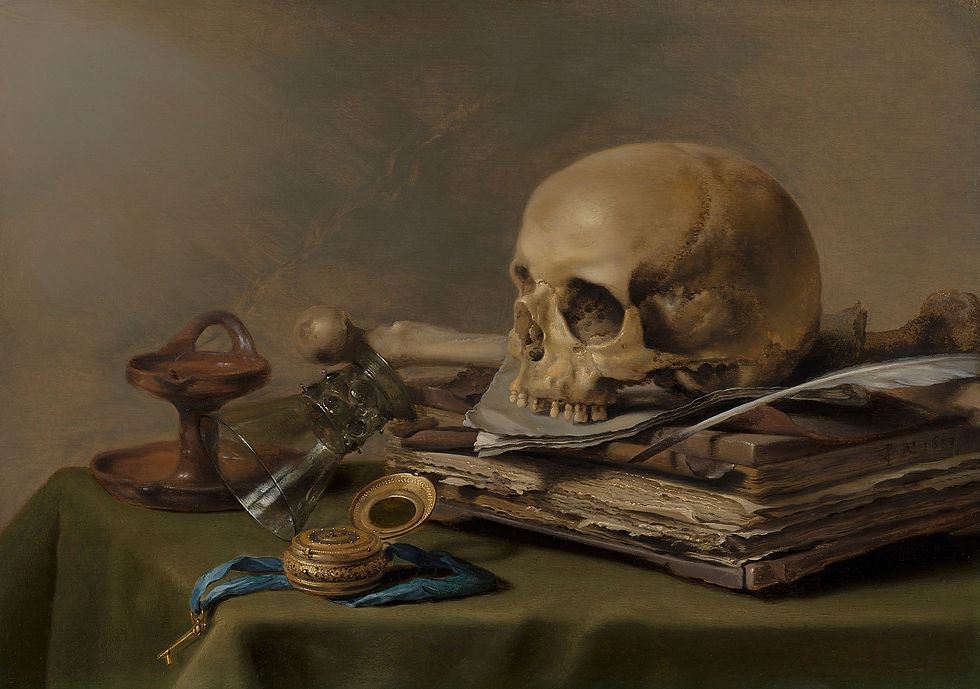
Vanitas paintings are rarely purely decorative. They almost always have a moral dimension. They serve as a reminder that wealth, beauty, knowledge, and power are fleeting, and that humans should not forget their own mortality.
Vanitas therefore often focuses on the end: on death as the inevitable horizon of all life.
Wabi-Sabi: The Beauty of What Has Come to Be
Wabi-Sabi approaches the same experience from a completely different angle.
While Vanitas offers a symbolic warning, Wabi-Sabi dwells on the concrete object, its surface, and the traces of time. Here, transience appears not primarily as a loss, but as a natural part of all becoming.

Cracks, signs of use, patina, or asymmetry are not signs of deficiency in Wabi-Sabi, but rather expressions of history and duration.
However, this is not simply a style of the “beautifully imperfect.” As I have already described in the article “Wabi-Sabi in Japan and Europe—Between Aesthetics and a Lived Attitude,” the difficulty of the concept lies precisely here: While Wabi-Sabi is one of the central aesthetics of Zen Buddhism, it is not a purely formal aesthetic. The perception of the imperfect is inextricably linked to an attitude: one of patience, acceptance, and a different understanding of time.
In the Western context, however, wabi-sabi is often aestheticized or stylized. The visible elements (natural materials, minimalism, imperfection) are adopted, while the underlying attitude often takes a back seat.
Two Cultures of Transience
The differences become particularly clear when compared:
Vanitas works with symbols; wabi-sabi works with the traces of time. Vanitas reminds people of their mortality; wabi-sabi accepts transience as a natural state.

The European tradition often frames transience as a warning, while the Japanese tradition meets it with value-free acceptance. Yet these two perspectives are not mutually exclusive; rather, they converge in the shared recognition that nothing can be preserved permanently.
And perhaps this is precisely why they remain relevant today.
In a present focused on optimization, acceleration, and constant renewal, both Vanitas and Wabi-Sabi appear as counter-movements. Both remind us that time leaves its mark, and that it is precisely in this that meaning arises. One tradition does this through the symbol of the end, the other through the beauty of what has come to be.

Exhibition:
VANITAS. DIE SCHÖNHEIT DES VERGÄNGLICHEN
28. MÄRZ 2026–20. SEPTEMBER 2026
Location: Museum la8, Lichtentaler Allee 8, 76530 Baden-Baden
AI was used to help draft this article. The topic, image selection, and editorial revisions were done without the use of AI. Translated with deepl.com.
Sources:


Comments