


Yobitsugi – The Invitation of the Foreign

In traditional ceramic repair, there are various techniques used to rejoin or restore damaged objects. In Tametsugi (Urushi-Tsugi), the broken shards are finished with colored urushi, such as dark red bengara urushi or black kuro urushi. In Kintsugi, the breaks are highlighted with a visible finish, such as gold. In Yobitsugi, a fragment from another ceramic vessel is used to fill in missing sections. Different ceramics, glazes, and surfaces come together and, through the repair, form a new unity.

Yobitsugi can thus be understood as a special form of kintsugi that adds another dimension to the concept of repair: Not only do the traces of the break remain visible, but the diversity of the materials utilized also becomes part of the design.
What does “Yobitsugi” mean?
The Japanese term “yobitsugi” (呼び継ぎ) is composed of “yobu” (呼ぶ), meaning “to call” or “to invite,” and “tsugi” (継ぎ), meaning “to connect” or “to join.” Literally, “yobitsugi” can therefore be understood as a kind of “repair by invitation.”
It refers to a technique in which fragments of various ceramic objects are joined together. The complementary piece, therefore, does not originally come from the vessel being repaired. It brings its own shape, color, glaze, and history to the object.

In practical repair work, this can be an obvious solution if the original fragment has been lost. At the same time, this technique opens up creative freedom that goes far beyond a purely functional replacement.
Depending on the desired effect, fragments can be selected that resemble the original ceramic as closely as possible. It is also possible to deliberately work with significant contrasts. Art historical literature describes a variety of ways in which foreign fragments have been used—ranging from extensive adaptation to the deliberate use of materials and forms that differ considerably from the original.
History of Yobitsugi
Yobitsugi has a long-standing connection to the Japanese tea ceremony and to the aesthetic developments that have emerged within the context of tea culture.
A particularly striking story is associated with the Sengoku period (1467–1615). This era was marked by political conflicts and nearly constant warfare. Under these conditions, the tea ceremony provided a unique social space where even rival figures could come together.

According to tradition, the tea ceramics used during peace negotiations were broken and then reassembled from the fragments. In this way, the ceramics of the various parties would have been connected to one another. Whether this event actually took place or is better understood as a legend cannot be clearly determined. Nevertheless, the story vividly conveys an idea that is characteristic of yobitsugi: the connection of different fragments can give rise to a new relationship between them.
Historically, Yobitsugi can also be linked to the development of Japanese tea culture and, in particular, to Sen no Rikyū (1522–1591). The aesthetic of wabi, which developed within the context of the tea ceremony, valued, among other things, simplicity, asymmetry, and the special effect of objects that defy a perfect or flawless appearance.
Yobitsugi and Wabi-Sabi
In this way, Yobitsugi directly touches upon the aesthetic philosophy of wabi-sabi.
As already described in the article “Wabi-Sabi in Japan and Europe—Between Aesthetics and a Way of Life,” however, it is helpful not to view wabi-sabi exclusively as an aesthetic style.
In Western usage, wabi-sabi is often associated with beauty in imperfection, with patina, aging, simplicity, and asymmetry. These aspects undoubtedly play a role. At the same time, wabi-sabi points to a broader attitude toward change and transience. It is precisely the connection between aesthetic perception and a particular way of viewing things that makes the concept so difficult to categorize precisely.
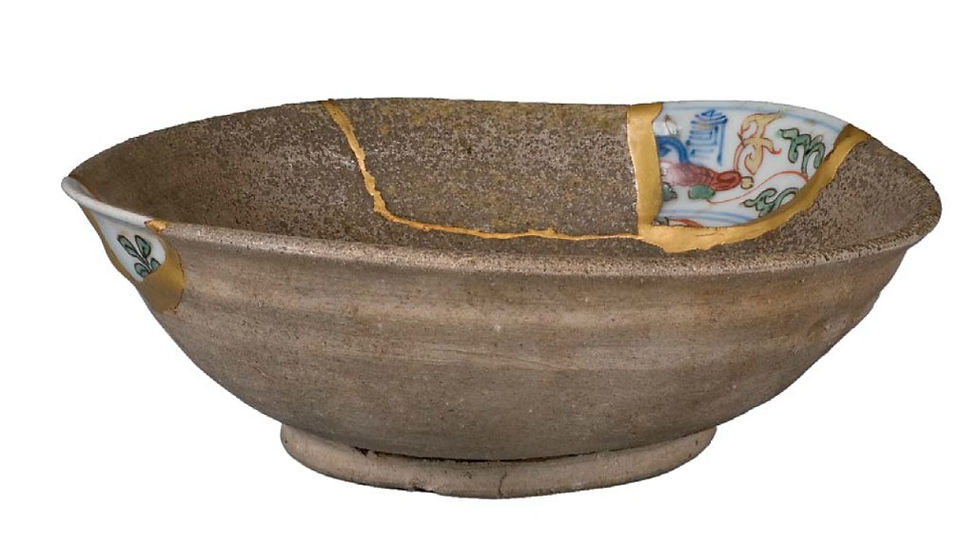
In Yobitsugi’s work, this connection becomes particularly evident. The different origins of the fragments are not necessarily viewed as something that must be balanced out in terms of design. Depending on the design, it is precisely the diversity of the materials that can define the character of the repaired object.
As a result, the object takes on a new composition in which the history of the original object is linked to the history of the added fragment.
Zwischen Reparatur und künstlerischer Gestaltung
Yobitsugi therefore operates in a realm where repair and redesign overlap.
The starting point may be a purely practical necessity: a part of the object is missing and must be replaced. But even the decision about which fragment to use for this purpose alters the object’s appearance. The shape, color, surface, and proportions of the new piece become components of a new overall composition.

In some cases, this aspect is taken even further. In the “Yobitsugi Tea Bowl” (picture above), a handmade piece by ceramic artist Katsunori Sawa, the fascinating landscapes of all four ceramic styles can be enjoyed in a single tea bowl. The depth of color of Shigaraki, fired in a wood-fired kiln, and the semi-transparency of Ki-Seto blend harmoniously with the delicate brushstrokes of Oribe and Shino, while the golden seams serve as accents and evoke admiration among connoisseurs.
Yobitsugi can thus result from a necessary repair or be employed as a deliberate artistic technique.
The Significance of the Foreign
A particular appeal of this technique lies in the fact that the added fragment retains its independence. It becomes part of the vessel without necessarily losing its original characteristics.
This creates an interesting form of polyphony. Different materials and shapes remain discernible but are connected through the shared repair. In this sense, Yobitsugi can also be understood as a kind of dialogue between different fragments.
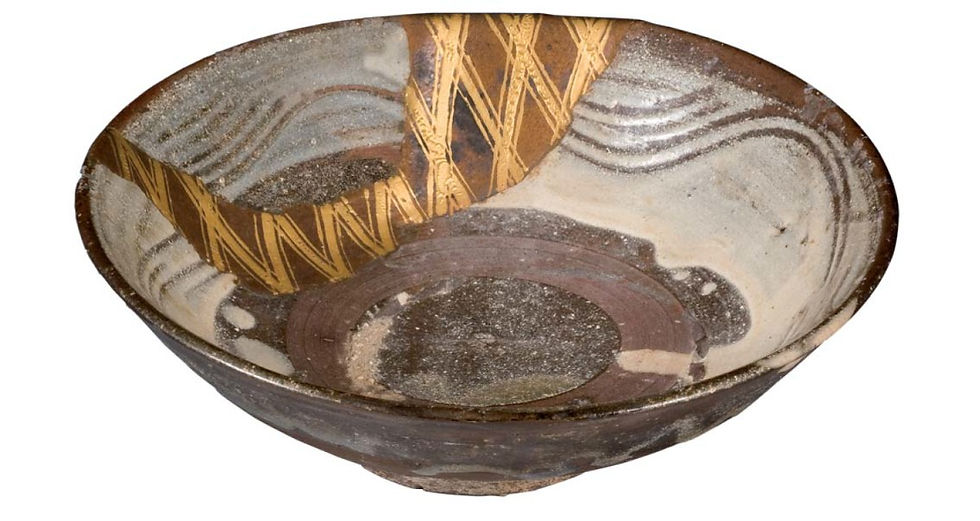
When examining repaired ceramics, it is precisely this connection between breakage and continuity that is often emphasized. The repair preserves the moment of damage while simultaneously revealing that the object continues its history. After the repair, it possesses a new identity that is based on its former state yet also points beyond it.
The added fragment thus becomes more than just a replacement for something missing; it adds another layer to the object’s history.
Yobitsugi and the Concept of Asobi
In addition to wabi and sabi, the concept of asobi is also of particular interest in connection with yobitsugi. Asobi can be roughly translated as “play,” “joy,” or “playful design” and represents an attitude that embraces diversity and a spirit of creative experimentation.
This aesthetic attitude is particularly associated with the tea master Furuta Oribe (1543/44–1615). Oribe valued unusual and, in some cases, highly distorted forms and used them to develop a design language that deliberately differed from an aesthetic focused exclusively on balance and perfection. Even the intentional alteration or damage of objects could become an artistic process in this context.
“Furuta Oribe discovered a captivating beauty in objects that were severely distorted or even deformed. This discovery led him ... to ... deliberately damage objects he considered ‘too perfect.’ In doing so, he either radically broke through the boundaries of the conventional design process or expanded them.” Charly Iten
For Yobitsugi, this perspective opens up a new avenue of exploration. The act of joining different fragments need not be driven solely by the intention to repair damage as harmoniously as possible. It can just as easily become a creative process in its own right, in which contrasts, different materials, and surprising combinations are deliberately encouraged.
A New Whole
Perhaps this is one of the most interesting aspects of yobitsugi: the repaired object not only references its past but also develops a new present through the repair. The original vessel remains recognizable, yet its identity is transformed by the added fragment. Two or more ceramic histories are woven together without their differences completely disappearing.
Viewed in this light, yobitsugi is more than just a technical variation on ceramic repair. The technique demonstrates how different fragments can come together to form a new unity that does not necessarily have to dissolve its diversity in order to be perceived as a whole.
Source:
Bartlett, Christy. “A Tearoom View of Mended Ceramics.” In Flickwerk: The Esthetics of Mended Caramics. Mūnster: Museum fūr Lackkunst, 2008.
Iten, Charly “Ceramics Mended with Lacquer – Fundamental Aesthetic Principles, Techniques and Artistic Concepts” In Flickwerk: The Esthetics of Mended Caramics. Mūnster: Museum fūr Lackkunst, 2008.
Atelier Muho “Kintsugi vs Yobitsugi: What's the Difference?” 2026.
Kogei Standard “A symphony of scenes” 2023.
Fallières, Didier “Variations on Kintsugi”, 2025.
ZenKiln “Yobitsugi: The Japanese Art of Patchwork Ceramic Repair”, 2026
AI was used to help draft this article. The topic, image selection, and editorial revisions were created without the use of AI. Translated with DeepL.com (free version)


Comments